Tomato Sauce With Preservatives vs. Without Preservatives: What Parents Should Know for Their Children

Overview
Tomato sauce (often called ketchup) is one of the most commonly consumed condiments in children's diets. It appears with snacks, meals, school tiffins, and restaurant food. Because it is used frequently and often in small amounts, many parents assume it is nutritionally insignificant. In reality, what goes into tomato sauce—and how often it is consumed—matters, particularly for young children whose bodies and brains are still developing.
This article explains, in detail:
- what preservatives are and why they are used in tomato sauce
- the most common preservatives found in sauces
- how preservatives interact with a child's developing system
- why "small amounts" can still matter when exposure is frequent
- how preservative-free sauces differ
- how parents can make informed, balanced choices
The goal is not fear, but informed guidance.
1. Why preservatives are used in tomato sauce
Commercial tomato sauce is designed to:
- sit on shelves for months (sometimes years)
- survive transportation and storage without refrigeration
- remain visually appealing and consistent in taste
- resist microbial growth after opening
To achieve this, manufacturers often rely on chemical preservatives in addition to salt, sugar, and acidity.
From an industrial perspective, preservatives:
- reduce spoilage losses
- extend shelf life
- stabilize color and flavor
- allow mass production at lower cost
From a child health perspective, the question is not whether preservatives "work," but whether repeated exposure during early development is desirable or necessary.
2. Common preservatives found in tomato sauce
While formulations vary by country and brand, commonly used preservatives include:
a) Sodium benzoate / Potassium benzoate
- Used to inhibit bacteria, yeast, and mold
- Effective in acidic foods like tomato sauce
b) Sulphites (less common but still present in some foods)
- Used as antimicrobial and antioxidant agents
c) Artificial stabilizers and acidity regulators
- Help maintain texture and pH stability
d) Flavor enhancers (often used alongside preservatives)
- Not preservatives themselves, but frequently co-occur in processed sauces
These substances are legally permitted within regulated limits, but legality does not automatically mean optimal for frequent consumption by young children.
3. Why children are more vulnerable than adults
1. Immature detoxification systems
Young children's:
- liver enzymes
- kidney filtration capacity
- gut barrier integrity
are still developing. This means they process and eliminate chemical additives more slowly and less efficiently than adults.
Repeated low-dose exposure can therefore have a disproportionately higher biological impact compared to the same intake in adults.
2. Higher intake relative to body weight
A child consuming 1–2 tablespoons of sauce daily is ingesting a much higher dose per kilogram of body weight than an adult eating the same amount.
This matters when exposure is chronic, even if each individual dose is "within limits."
3. Developing gut microbiome
Early childhood is a critical period for:
- gut microbiome diversity
- immune system training
- metabolic programming
Some preservatives have antimicrobial properties by design. While this is useful for food preservation, repeated exposure may unintentionally affect beneficial gut bacteria, especially when combined with other ultra-processed foods.
A less diverse gut microbiome has been associated (in broader dietary research) with:
- increased inflammation
- metabolic dysregulation
- immune sensitivity
4. Potential concerns linked to preservatives in children's diets
It is important to be precise and responsible here. Preservatives are not "poison," but patterns of exposure matter.
1. Behavioral sensitivity in some children
Certain children appear more sensitive to food additives, showing:
- increased restlessness
- irritability
- difficulty with emotional regulation
This does not occur in all children, but when it does, parents often notice improvement when additive-heavy foods are reduced.
2. Taste conditioning toward ultra-processed foods
Preserved sauces are often:
- highly sweetened
- intensely flavored
- designed for sensory impact
This trains a child's palate to expect exaggerated sweetness, uniform taste, and instant flavor payoff. Over time, it can reduce acceptance of fresh vegetables, home-cooked foods, and naturally flavored meals. Preservatives are not acting alone here, but they are part of a processed food package that shapes long-term eating behavior.
3. Cumulative exposure effect
A child may consume preservatives from:
- sauces
- packaged snacks
- bread
- ready-to-eat foods
- beverages
Each individual product may meet safety limits, but children do not consume foods in isolation. The cumulative daily exposure is what concerns nutrition and public health experts.
4. Masking poor ingredient quality
Preservatives allow manufacturers to use lower-quality raw materials, rely less on freshness, and compensate for long storage times.
Preservative-free products, by necessity, often require better-quality tomatoes, stricter hygiene, shorter supply chains, and more transparent labeling.
5. Tomato sauce without preservatives: how it is different
Preservative-free tomato sauce typically relies on:
- natural acidity of tomatoes
- heat processing (pasteurization)
- airtight packaging
- refrigeration after opening
- shorter shelf life
Practical differences parents will notice:
- shorter "best before" period
- clearer ingredient lists
- less aggressive sweetness
- flavor closer to real tomatoes
Importantly, preservative-free does not mean nutritionally perfect—sugar and salt content still matter—but it removes one layer of chemical exposure from a child's diet.
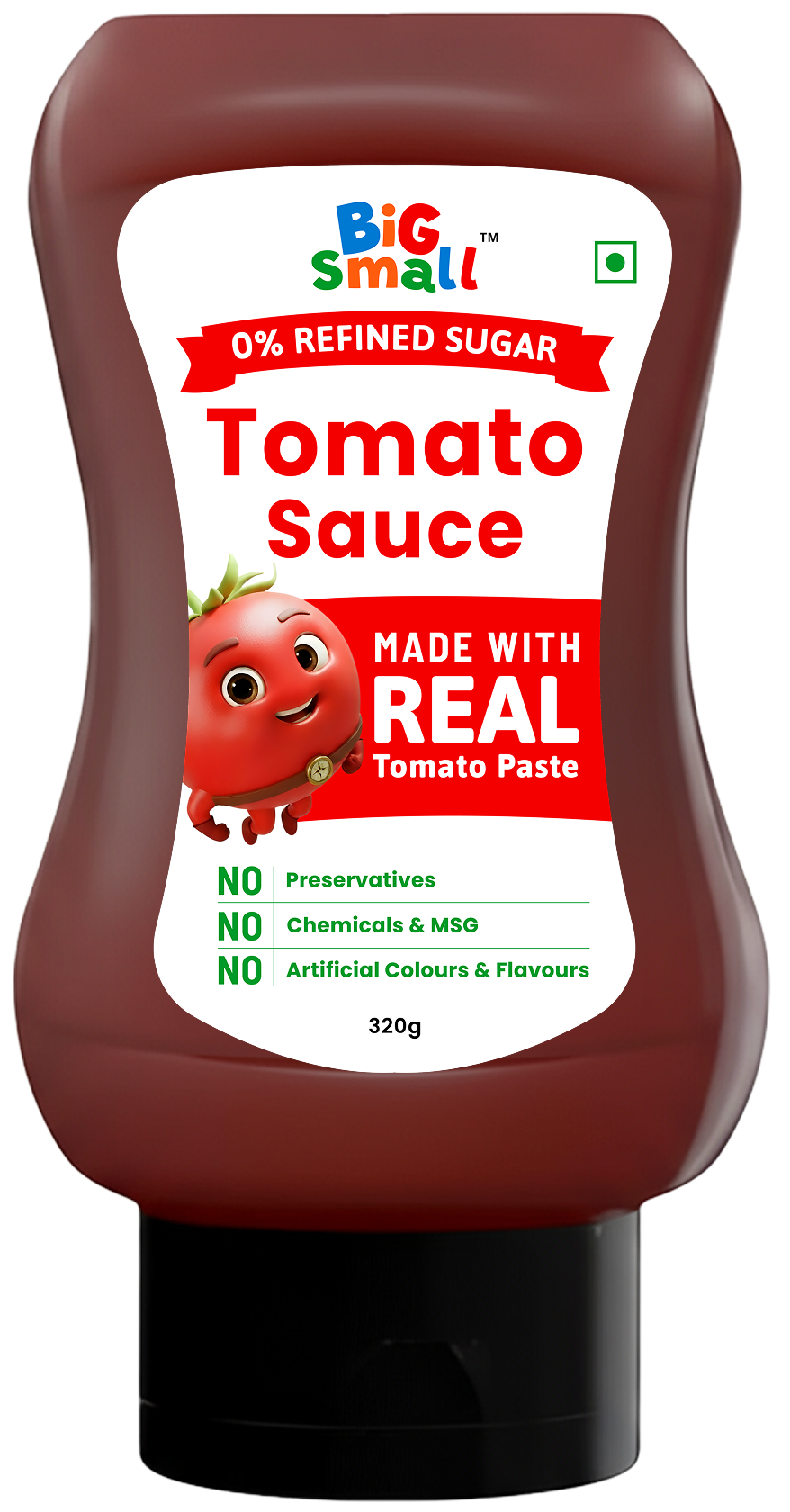
BiGSmall Kids Tomato Sauce
Real tomatoes, Jaggery, No Refined Sugar, No Added Preservatives, No Artificial Flavours, No Artificial Colors or Chemicals | Sweetened Only with Jaggery Made for everyday meals.
Shop now6. Why this matters specifically in kids' food
Children aged 2–10:
- eat smaller quantities but more frequently
- repeat the same foods daily
- develop lifelong preferences during this period
A sauce used every day, on multiple foods, or as a flavor "bridge" becomes a dietary habit, not an occasional indulgence.
When that habit includes preservatives, artificial flavours, and high sugar, it quietly normalizes ultra-processed food as "everyday food."
7. A balanced, realistic parental perspective
This is not about demonizing preservatives, creating food fear, or expecting perfection.
It is about:
- reducing unnecessary exposure where easy alternatives exist
- choosing simpler ingredient lists for foods children eat often
- reserving heavily processed foods for occasional use
Practical guidance:
- If a food is used daily, aim for the cleanest version available
- If a food is used occasionally, flexibility matters more
- Read labels, not marketing claims
- Fewer ingredients is usually better
8. The bigger picture: what children actually learn from food choices
Children absorb messages such as:
- "Food comes from packets."
- "Food lasts forever."
- "Flavor comes from additives."
- "Sweet and tangy is normal."
Preservative-free choices—especially when combined with home food—teach a different lesson:
- food has seasons and limits
- freshness matters
- taste does not need exaggeration
- the body deserves care
Final takeaway
The big deal about preservatives in tomato sauce is not panic—it is pattern.
- Preservatives exist to serve industrial needs, not developmental ones.
- Children's bodies are more sensitive to repeated exposure.
- Tomato sauce is a frequent, habitual food in many children's diets.
- Removing preservatives where possible is a low-effort, high-impact improvement.
Choosing tomato sauce without preservatives, artificial colors, artificial flavours, or added MSG—especially for regular use—is a reasonable, protective decision, not an extreme one.
Parents do not need to eliminate tomato sauce. They need to choose better versions and use them mindfully.
Related posts

How to Shape Healthy Eating Habits in Children (Without Control or Food Battles)
Children are born with the ability to regulate hunger—but parental pressure, restriction, and emotional feeding can quietly disrupt it. This guide explains how parents can provide structure and guidance without control, helping children build a lifelong healthy relationship with food.
6 min read
Foods to Avoid for Kids Aged 2–6: A Parent’s Guide to Building Healthy Eating Habits
What children eat between ages 2 and 6 shapes their taste preferences, metabolism, and long-term relationship with food. This guide explains which foods to avoid or limit, why early eating habits matter, and how parents can guide children toward healthier choices without pressure or food battles.
8 min read
Ragi vs Oats for Kids: What to Choose for Everyday Meals
A balanced look at ragi (finger millet) and oats for children—nutrition, bone health, digestion, and how each fits into everyday meals, plus practical tips for parents.
6 min read